A Guide to Workload Types and Resource Planning
The artificial intelligence revolution is fundamentally reshaping how we think about computing infrastructure. As AI applications proliferate across healthcare diagnostics, financial modeling, autonomous vehicles, and real-time recommendation engines, the infrastructure supporting these workloads has evolved from a nice-to-have to a strategic differentiator. Yet for many organizations, the path from AI ambition to production deployment is littered with costly missteps: over-provisioned clusters that drain budgets, under-powered systems that throttle innovation, and architectures that can’t scale with growing demands.
The challenge isn’t just technical—it’s strategic. Unlike traditional enterprise applications that follow predictable resource patterns, AI workloads span an enormous spectrum of computational requirements. Training a small custom model might need a single GPU for hours, while developing a large language model could require hundreds of GPUs for weeks. Real-time inference applications demand millisecond response times, while batch processing jobs prioritize throughput over latency.
This complexity means that the “more is better” approach to infrastructure planning—common in the early days of cloud adoption—simply doesn’t work for AI. Over-provisioning leads to wasted capital and inflated operating expenses. Under-provisioning results in missed performance targets, elongated development cycles, and frustrated data science teams. The organizations that succeed are those that master the art of right-sizing: deploying precisely the resources needed to meet performance objectives without unnecessary cost or complexity.
The AI Infrastructure Landscape: More Than Just GPUs
When most people think about AI infrastructure, they immediately jump to GPUs—and for good reason. Graphics Processing Units have become the workhorses of artificial intelligence, delivering the parallel processing power that makes modern machine learning possible. But successful AI infrastructure is far more nuanced than simply adding more GPUs to a rack.
Consider the data pipeline that feeds these compute engines. AI models are notoriously hungry for data, often requiring terabytes of training information that must be preprocessed, augmented, and delivered to compute nodes with precise timing. A GPU capable of processing thousands of operations per second becomes worthless if it’s waiting for data to arrive from storage. This is why memory bandwidth, storage throughput, and network connectivity are often more critical to overall performance than raw compute power.
The cooling requirements add another layer of complexity. Modern AI accelerators generate tremendous heat—an NVIDIA H200 GPU can consume up to 700 watts under full load, roughly equivalent to seven high-end desktop computers. Traditional air cooling struggles to maintain optimal temperatures under sustained AI workloads, leading to thermal throttling that can reduce performance by 10-30% within minutes of starting intensive training. This is why innovative cooling solutions, including immersion cooling technologies, are becoming essential for organizations serious about maximizing their AI investments.
Training vs. Inference: Two Sides of the AI Coin
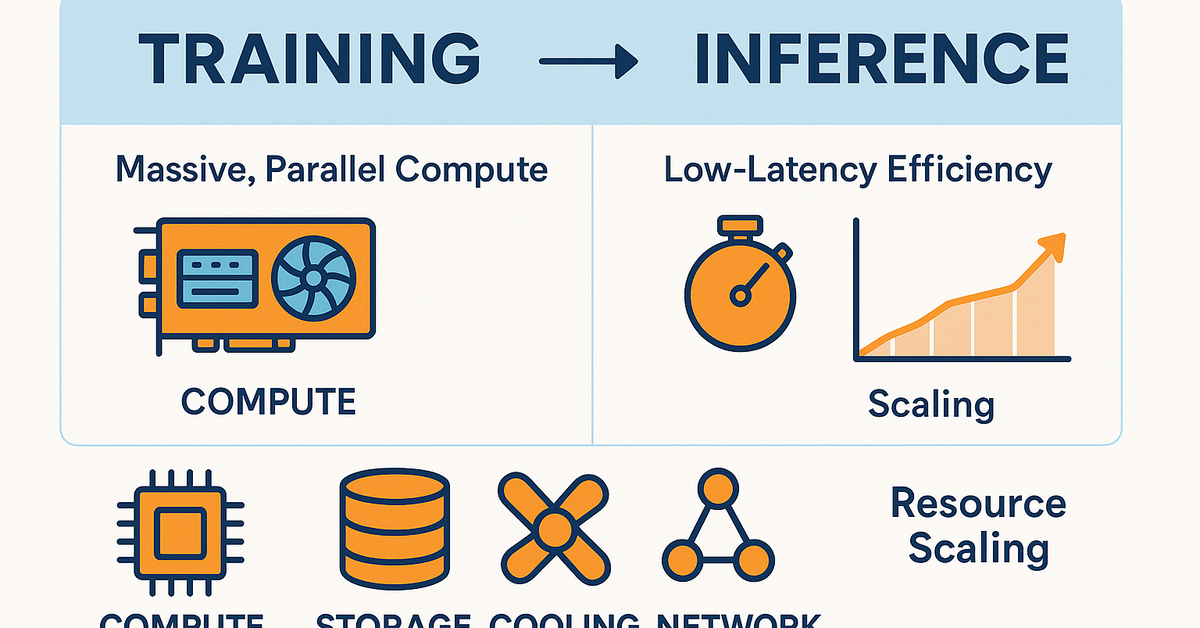
Understanding the fundamental distinction between training and inference workloads is crucial for making informed infrastructure decisions. These two phases of the AI lifecycle have dramatically different requirements, and conflating them leads to suboptimal resource allocation.
Training: The Resource-Intensive Foundation
Training is where AI models learn patterns from data—and it’s computationally expensive by design. During training, models process massive datasets multiple times, adjusting billions of parameters through iterative optimization. This phase demands:
Massive Parallel Compute: Training large language models like GPT or Claude requires hundreds of GPUs working in perfect synchronization. Each GPU must perform trillions of floating-point operations while constantly exchanging gradient information with its peers.
High-Bandwidth Memory: Modern AI models often have memory requirements that dwarf traditional applications. A 100-billion parameter language model needs over 400GB just to store its weights, before accounting for activations, optimizer states, and gradient buffers.
Fast Interconnects: When dozens of GPUs collaborate on training, they generate enormous amounts of inter-node traffic. Gradient synchronization can consume hundreds of gigabits per second of bandwidth, making high-speed networking like InfiniBand essential for large-scale training.
Sustained Performance: Training runs can last days or weeks. Unlike traditional batch jobs that might accept some performance variability, AI training requires consistent throughput to maintain convergence rates and meet project deadlines.
Inference: Speed and Efficiency at Scale
Inference is where trained models make predictions on new data—the production phase that delivers business value. While less computationally intensive per operation than training, inference creates its own unique challenges:
Latency Sensitivity: Production AI applications often need to respond in milliseconds. A recommendation engine that takes 500ms to suggest products will frustrate users. An autonomous vehicle that takes 100ms to detect obstacles could cause accidents.
Concurrency Demands: A single inference request might be lightweight, but production systems must handle thousands of simultaneous requests. This requires different architectural choices than the batch-oriented approach of training.
Cost Optimization: While training happens periodically, inference runs continuously, making cost per operation critical. Organizations often choose different hardware for inference than training, prioritizing efficiency over raw performance.
Deployment Flexibility: Inference often happens closer to users—in edge data centers, on-premises installations, or even embedded devices. This distributed requirement influences everything from power consumption to form factor choices.
Model Complexity: From Prototypes to Production Giants
The scale of AI models has exploded over the past decade, creating a spectrum of infrastructure requirements that ranges from single-workstation experiments to supercomputer-class installations.
Small and Custom Models: The Innovation Playground
At the smaller end of the spectrum, models with tens to hundreds of millions of parameters serve as the foundation for rapid experimentation and specialized applications. These models can typically train on a single high-end GPU with 16-24GB of memory, making them accessible to startups, researchers, and organizations just beginning their AI journey.
The infrastructure requirements for small models are relatively modest: a workstation-class server with one or two GPUs, sufficient RAM for data preprocessing, and fast local storage for datasets and checkpoints. This accessibility is crucial—it allows teams to iterate quickly, test hypotheses, and develop domain expertise without massive upfront infrastructure investments.
However, “small” is relative in the AI world. Even a 100-million parameter model represents significant computational work, and the supporting infrastructure—data pipelines, experiment tracking, model versioning—can quickly become complex as teams mature their ML operations.
Large-Scale Models: The Frontier of AI Capability
At the other extreme, large language models and foundation models push the boundaries of what’s computationally possible. These systems, with billions to trillions of parameters, require infrastructure that rivals traditional high-performance computing installations.
Training GPT-3, for example, required 175 billion parameters and consumed an estimated 3,640 petaflop-days of compute. This translates to hundreds of GPUs running continuously for weeks, consuming megawatts of power and generating enormous amounts of heat. The infrastructure requirements extend far beyond compute:
Distributed Storage: Training datasets often exceed petabytes in size, requiring high-performance distributed storage systems that can deliver sustained throughput to hundreds of compute nodes simultaneously.
Fault Tolerance: When training runs cost hundreds of thousands of dollars in compute time, hardware failures become existential risks. Advanced checkpointing, redundant storage, and automated recovery systems become essential.
Network Architecture: Large model training generates communication patterns that can overwhelm traditional data center networks. Specialized topologies and protocols, designed specifically for AI workloads, become necessary to maintain training efficiency.
Domain-Specific Infrastructure Patterns
Different AI application domains create distinct infrastructure requirements, each optimized for specific types of data processing and computational patterns.
Computer Vision: High-Throughput Image Processing
Computer vision applications process visual data—images, video streams, and sensor feeds—creating unique infrastructure demands:
Memory for Visual Data: High-resolution images and video frames consume enormous amounts of memory. Processing 4K video streams requires GPUs with large memory buffers and high bandwidth to handle the constant data flow.
Specialized Processing Units: Modern GPUs include dedicated video encoders and decoders that accelerate common computer vision tasks. Choosing hardware with these specialized units can dramatically improve performance for specific workloads.
Storage Bandwidth: Image datasets are notoriously large. ImageNet, a standard computer vision dataset, contains over 14 million images totaling hundreds of gigabytes. Training modern vision models requires storage systems that can deliver this data to GPUs without creating bottlenecks.
Natural Language Processing: Memory and Attention
NLP applications, particularly those based on transformer architectures, create different infrastructure challenges:
Memory Bandwidth Intensity: Transformer models spend much of their time moving data rather than computing. The attention mechanism requires constant access to large embedding tables, making memory bandwidth often more important than compute throughput.
Sequence Length Scaling: Longer input sequences create quadratic increases in memory requirements. Processing documents or long conversations requires GPUs with substantial memory capacity.
Tokenization and Preprocessing: NLP workflows often involve complex text preprocessing pipelines that can be CPU-intensive, requiring balanced CPU-GPU ratios different from other AI domains.
Recommendation Systems: Scale and Real-Time Response
Recommendation engines present unique challenges that blend aspects of traditional databases with AI inference:
Embedding Table Management: Modern recommendation systems use enormous embedding tables that capture user and item representations. These tables can exceed GPU memory capacity, requiring sophisticated memory management strategies.
Real-Time Constraints: Unlike batch training or offline inference, recommendation systems must respond to user actions in real-time. This creates infrastructure requirements similar to high-frequency trading systems.
Feature Store Integration: Recommendation systems consume vast amounts of real-time feature data—user behavior, inventory levels, pricing information. The infrastructure must efficiently integrate these data streams with inference pipelines.
Infrastructure Component Deep Dive
Understanding how individual infrastructure components support AI workloads provides the foundation for making informed architecture decisions.
Compute: Beyond Traditional Processing
CPUs: The Orchestra Conductors While GPUs grab headlines in AI infrastructure, CPUs remain essential for orchestrating complex AI workflows. They handle data preprocessing, coordinate distributed training, manage system resources, and execute the business logic that surrounds AI models. Modern AI infrastructure typically requires high-core-count CPUs with substantial cache and memory bandwidth to avoid bottlenecking GPU utilization.
GPUs: The Parallel Powerhouses Graphics Processing Units have become synonymous with AI acceleration due to their architecture optimized for parallel operations. Key considerations include:
- Memory Capacity: Modern AI models often require 16GB, 32GB, or even 80GB of GPU memory. Insufficient memory forces costly data movement between GPU and system memory.
- Memory Bandwidth: The speed at which data moves between compute units and memory often determines overall performance. High-bandwidth memory (HBM) technologies provide the throughput needed for large models.
- Interconnect Support: For multi-GPU systems, specialized interconnects like NVIDIA’s NVLink enable direct GPU-to-GPU communication, essential for efficient distributed training.
Specialized Accelerators: Purpose-Built Performance Beyond traditional GPUs, specialized accelerators like Google’s TPUs and various AI ASICs offer optimized performance for specific workloads. These devices trade flexibility for efficiency, often delivering superior performance-per-watt for targeted applications.
Memory and Storage: The Data Highway
High-Bandwidth Memory (HBM): Speed at a Premium HBM provides the extreme bandwidth required by modern AI accelerators. With throughput measured in terabytes per second, HBM enables GPUs to sustain high utilization rates during memory-intensive operations like attention computations in transformers.
System Memory: The Staging Area Host system memory serves as a staging area for datasets, intermediate results, and coordination between distributed nodes. AI workloads often require 512GB or more of system memory to avoid bottlenecks in data feeding and inter-process communication.
Storage Hierarchy: From Hot to Cold AI infrastructure typically employs a multi-tier storage strategy:
- NVMe SSDs: Provide ultra-low latency for active datasets and model checkpoints
- High-capacity SSDs: Store preprocessed datasets and intermediate results
- Object Storage: Offer cost-effective long-term storage for raw datasets and model archives
Networking: The Connective Tissue
High-Speed Interconnects: Keeping GPUs Fed Multi-GPU training generates enormous amounts of inter-node communication. Technologies like InfiniBand and RDMA (Remote Direct Memory Access) provide the low-latency, high-bandwidth connectivity essential for maintaining training efficiency across distributed systems.
Network Topology: Avoiding Bottlenecks The physical arrangement of network connections—leaf-spine architectures, fat-tree topologies, and custom GPU-optimized designs—determines whether networks can sustain the communication patterns generated by large-scale AI training.
Real-Time vs. Batch Processing: Architecture Implications
The temporal requirements of AI applications fundamentally shape infrastructure architecture decisions.
Real-Time Processing: Milliseconds Matter
Real-time AI applications—autonomous vehicles, fraud detection, real-time recommendations—require infrastructure optimized for consistent, low-latency response:
Dedicated Resources: Shared infrastructure introduces latency variability that can violate real-time constraints. Critical applications often require dedicated compute resources to ensure predictable performance.
Edge Deployment: Minimizing network hops by deploying inference capabilities closer to users reduces latency and improves reliability.
Specialized Hardware: Purpose-built inference accelerators often provide better latency characteristics than general-purpose training hardware.
Batch Processing: Throughput Optimization
Batch AI workloads—model training, large-scale inference, data preprocessing—prioritize overall throughput over individual operation latency:
Resource Sharing: Batch workloads can efficiently share infrastructure, maximizing utilization and reducing costs.
Spot and Preemptible Instances: Non-urgent batch jobs can leverage lower-cost computing options that may be interrupted, significantly reducing operational expenses.
Storage Optimization: Batch workloads can employ storage strategies optimized for sequential access patterns rather than random access performance.
Preparing for the Sizing Journey
Understanding these foundational concepts—the distinction between training and inference, the impact of model scale, domain-specific requirements, and infrastructure component interactions—prepares you for the critical next step: translating these abstract requirements into precise resource specifications.
The organizations that succeed in AI understand that infrastructure decisions made today will either enable or constrain their capabilities for years to come. A well-architected foundation provides the flexibility to experiment rapidly, scale successful projects, and adapt to evolving business requirements. Conversely, infrastructure mismatches create technical debt that compounds over time, eventually requiring expensive migrations or redesigns.
In our next article, we’ll dive deep into the methodology for translating these requirements into specific hardware configurations, providing step-by-step guidance for calculating compute needs, sizing memory and storage, and planning for growth. We’ll explore the tools and techniques that allow you to move from understanding what you need to precisely specifying how much you need—the crucial bridge between AI ambition and production reality.
The future belongs to organizations that can efficiently translate AI potential into business value. That journey begins with infrastructure that matches your ambitions—neither over-engineered to the point of financial strain nor under-powered to the point of performance compromise. Understanding your requirements is the first step in building that foundation.