From Crisis to Solution: Rethinking Data Center Cooling
In our previous article, we explored how traditional air cooling has hit an insurmountable wall, struggling to manage the thermal demands of modern AI and high-performance computing workloads. The industry’s response isn’t incremental improvement—it’s a fundamental reimagining of how we cool computing infrastructure. Enter immersion cooling: a technology that places entire servers directly into thermally conductive, electrically non-conductive liquids.
While this might sound like science fiction, immersion cooling has deep historical roots. The Cray-2 supercomputer, deployed in 1985, was famously immersed in Fluorinert fluid to manage its extraordinary heat output. What was once an exotic solution for the world’s most powerful computers is now becoming a practical necessity for mainstream data centers grappling with GPU-intensive workloads.
The Physics Advantage: Why Liquids Dominate
The fundamental superiority of liquid cooling over air stems from basic thermodynamics. Liquids possess thermal properties that make air cooling look primitive by comparison:
Heat Capacity: Water has approximately 4,000 times the heat capacity of air. This means a given volume of liquid can absorb dramatically more thermal energy before experiencing significant temperature rise. Even specialized dielectric fluids used in immersion cooling maintain heat capacities orders of magnitude superior to air.
Thermal Conductivity: Liquids conduct heat roughly 25-30 times more effectively than air. This superior conductivity enables direct contact heat transfer, eliminating the thermal resistance layers that plague air-cooled systems where heat must transfer from chip to heat sink to air.
Density and Flow Characteristics: The density of liquids allows for more efficient heat transport through convection. A small pump can circulate coolant far more effectively than the massive fans required for equivalent air movement, while operating at significantly lower energy consumption.
These physical advantages translate into practical benefits that transform data center capabilities. Where air cooling requires complex airflow management, hot aisle containment, and massive HVAC systems, immersion cooling achieves superior results with elegant simplicity.
Single-Phase Immersion: Direct Heat Absorption
Single-phase immersion cooling represents the more straightforward implementation of liquid cooling technology. In this approach, servers are completely submerged in a dielectric fluid that remains in liquid state throughout the cooling process. The fluid absorbs heat directly from components and is circulated through external heat exchangers for temperature regulation.
How It Works: Components generate heat that is immediately absorbed by the surrounding dielectric fluid. Circulation pumps move the heated fluid to external heat exchangers (typically dry coolers or cooling towers) where heat is rejected to the environment. The cooled fluid then returns to the immersion tank, creating a continuous cooling loop.
Fluid Characteristics: Single-phase systems typically use engineered fluids with specific properties optimized for electronics cooling. These fluids must be electrically non-conductive, chemically inert with electronic components, environmentally safe, and thermally stable across operating temperature ranges. Modern formulations achieve these requirements while maintaining excellent heat transfer properties.
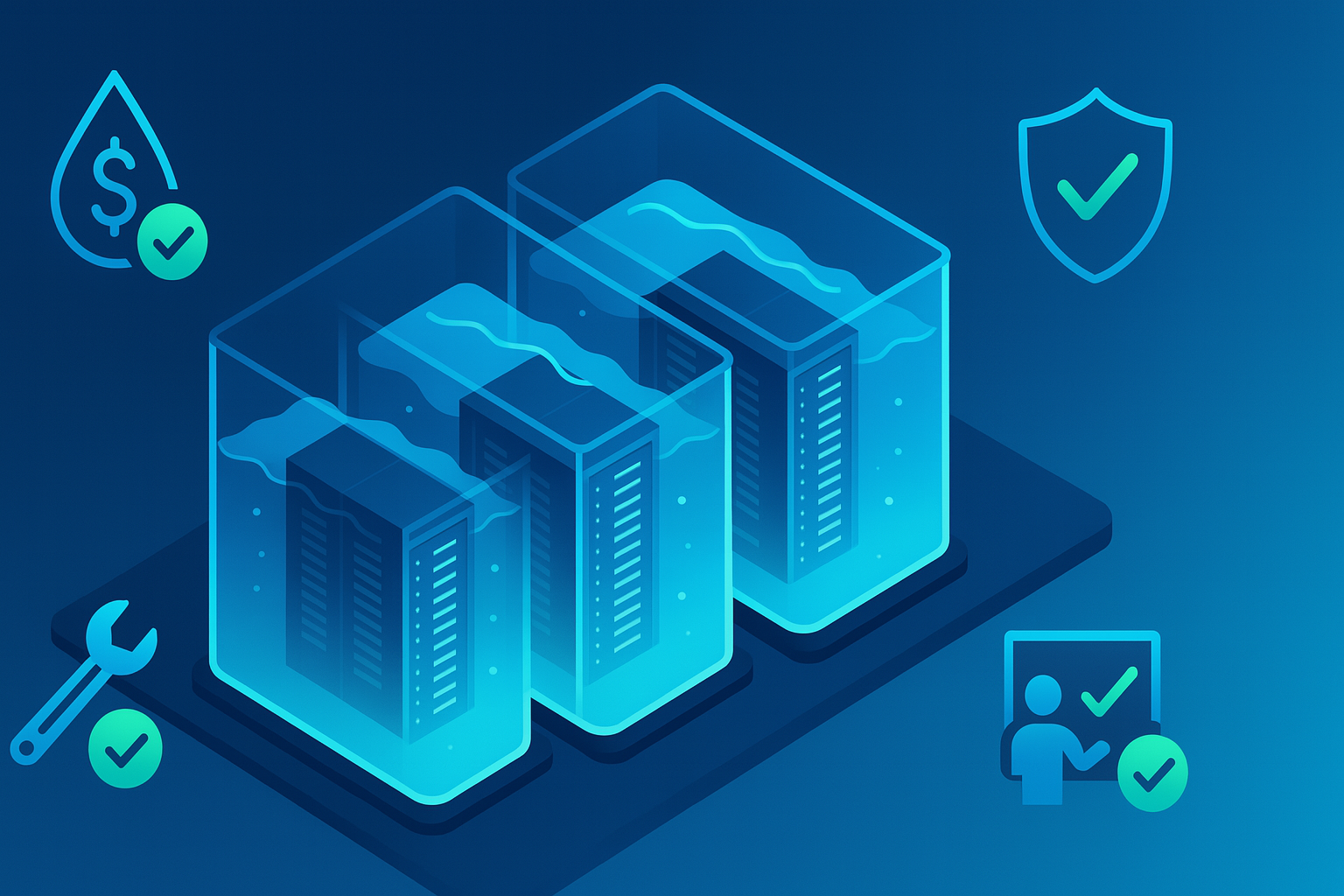
System Design: Single-phase immersion systems resemble sophisticated aquariums for servers. Sealed tanks contain the immersed hardware with inlet and outlet connections for fluid circulation. Temperature monitoring throughout the tank ensures uniform cooling, while filtration systems maintain fluid purity. The external heat rejection system can integrate with existing facility cooling infrastructure or operate independently.
Performance Characteristics: Single-phase systems typically achieve 20-30% reductions in total facility energy consumption compared to air cooling. They enable rack power densities of 50-100kW while maintaining optimal component temperatures. The stable thermal environment reduces thermal cycling stress on components, potentially extending hardware lifespan significantly.
Two-Phase Immersion: The Power of Phase Change
Two-phase immersion cooling harnesses the latent heat of vaporization to achieve even more dramatic cooling performance. In this approach, the dielectric fluid boils at relatively low temperatures (typically 50-65°C), absorbing enormous amounts of energy during the phase change from liquid to vapor.
The Phase Change Advantage: When a liquid vaporizes, it absorbs substantial energy without temperature increase—this is latent heat. The energy required to vaporize water at 100°C, for example, is equivalent to heating the same mass of water from 0°C to 100°C. This phenomenon enables two-phase cooling to handle extreme heat densities that would be impossible with single-phase systems.
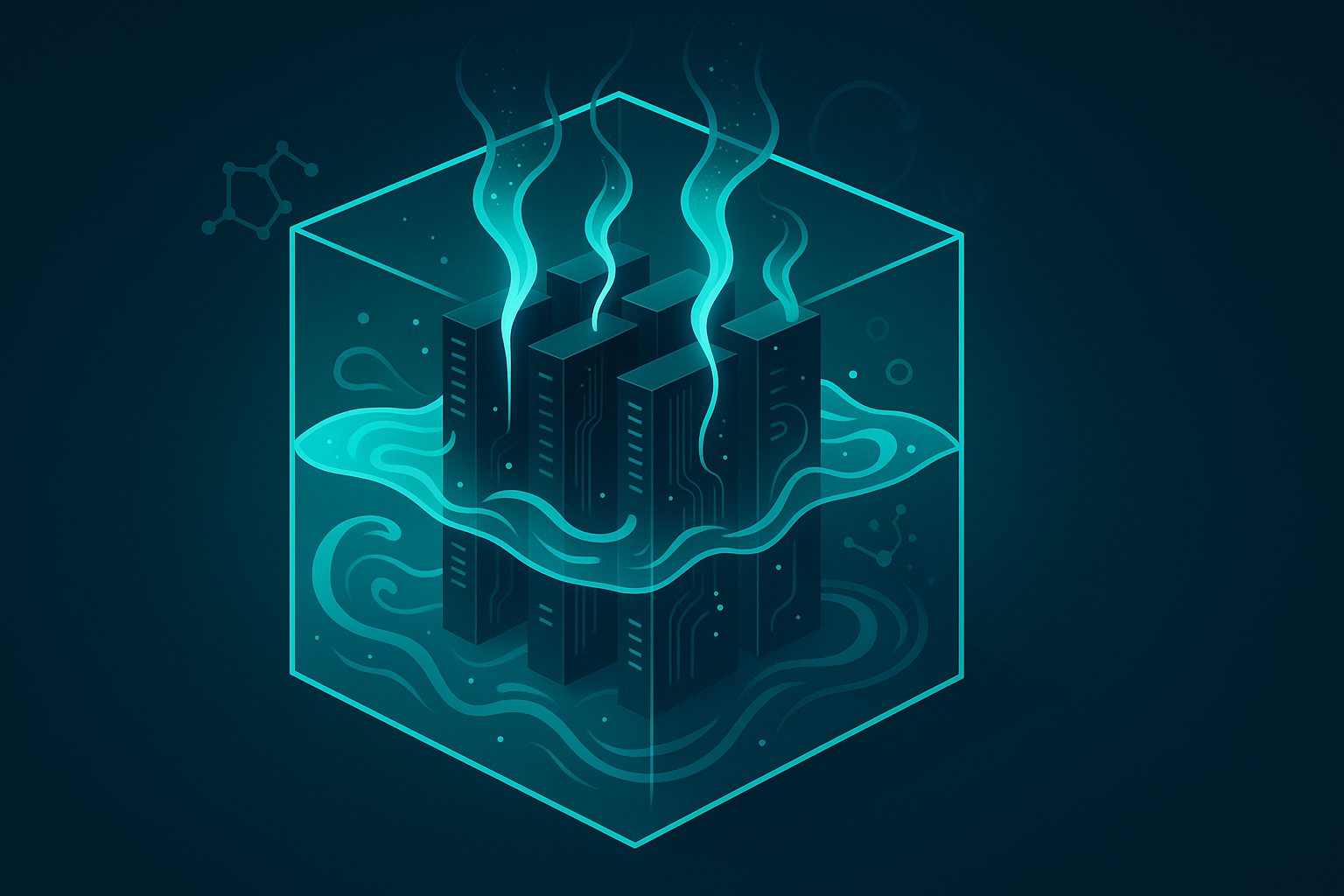
System Operation: Components heat the dielectric fluid until it reaches its boiling point and begins vaporizing. The vapor rises through the tank and encounters a condenser (typically cooled by facility water or air systems) where it returns to liquid state. Gravity returns the condensed fluid to the tank bottom, completing the thermosiphon cycle. This process is entirely passive—no pumps are required for the primary cooling loop.
Fluid Engineering: Two-phase fluids are specifically engineered to boil at temperatures optimal for electronics cooling while maintaining all the safety and compatibility characteristics required for direct component contact. These specialized fluids often cost significantly more than single-phase alternatives but deliver correspondingly superior performance.
Extreme Performance: Two-phase systems can handle power densities exceeding 200kW per rack while maintaining component temperatures well within operational specifications. The passive nature of heat transport eliminates pump failures as a potential point of system failure. Microsoft’s recent deployment of two-phase immersion cooling allows their servers to operate continuously at full power with no thermal throttling—a capability impossible with air cooling.
Dielectric Fluids: The Unsung Heroes
The success of immersion cooling depends entirely on the properties of dielectric fluids—engineered liquids designed to safely contact electronic components while providing superior heat transfer. These fluids represent decades of chemical engineering optimization for the unique requirements of electronics cooling.
Electrical Properties: Dielectric fluids must maintain extremely high electrical resistivity to prevent short circuits or component damage. Modern formulations achieve resistivity levels exceeding 10^12 ohm-cm, ensuring complete electrical safety even with powered components. This electrical isolation is maintained across temperature ranges and after extended exposure to electronic materials.
Chemical Compatibility: Electronics contain numerous materials—metals, plastics, adhesives, coatings—that must remain stable in prolonged contact with cooling fluids. Dielectric fluids undergo extensive compatibility testing to ensure they don’t degrade component materials, dissolve protective coatings, or cause galvanic corrosion between dissimilar metals.
Environmental and Safety Considerations: Modern dielectric fluids are designed for environmental responsibility and worker safety. Many formulations are biodegradable, have low global warming potential, and present minimal health hazards during normal handling. This represents a significant advancement over early immersion fluids that often had environmental or safety concerns.
Thermal Performance Optimization: Beyond safety requirements, dielectric fluids are optimized for heat transfer performance. This includes viscosity characteristics that balance flow efficiency with heat transfer coefficients, thermal stability that prevents degradation under operating conditions, and specific heat properties that maximize energy absorption capabilities.
System Architecture and Integration
Modern immersion cooling systems integrate sophisticated monitoring, control, and safety systems that rival traditional data center infrastructure in complexity and reliability.
Thermal Management: Advanced temperature monitoring throughout immersion tanks ensures uniform cooling and identifies potential hot spots before they impact performance. Automated flow control adjusts circulation rates based on real-time thermal loads. Integration with facility management systems provides centralized monitoring and control comparable to traditional cooling infrastructure.
Filtration and Fluid Management: Immersion systems include filtration to maintain fluid purity and remove any particles that could impact performance or component reliability. Fluid level monitoring ensures adequate immersion depth, while automated makeup systems compensate for minor fluid losses. Some systems include online fluid analysis to monitor chemical properties and predict maintenance requirements.
Safety Systems: Comprehensive leak detection protects against fluid loss and potential environmental impacts. Emergency shutdown systems can quickly isolate immersion tanks in the event of system anomalies. Fire suppression systems are specifically designed for immersion cooling environments, often using clean agents that won’t damage electronics or contaminate cooling fluids.
Maintenance Access: Despite complete immersion, modern systems provide practical maintenance access through quick-disconnect fittings, component lifting systems, and procedures for safely removing hardware for service. Some designs allow hot-swapping of components without draining tanks, maintaining operational continuity during maintenance activities.
Comparing Approaches: Air, Direct Liquid, and Immersion
Understanding immersion cooling requires context of how it compares to alternative cooling approaches, each with distinct advantages and limitations.
Air Cooling Limitations: Traditional air cooling requires moving large volumes of air to achieve modest heat transfer. The thermal resistance between components and air creates temperature differentials that limit performance and efficiency. Complex airflow management, hot aisle containment, and massive HVAC systems add infrastructure complexity and energy consumption while still failing to meet modern thermal demands.
Direct-to-Chip Liquid Cooling: Direct liquid cooling uses cold plates or heat exchangers attached to specific high-heat components like CPUs and GPUs. While more effective than air cooling, this approach addresses only the highest-power components, leaving other heat-generating elements (memory, power supplies, network interfaces) to air cooling. The hybrid approach reduces overall efficiency and maintains infrastructure complexity.
Immersion Cooling Advantages: Immersion cooling addresses every component simultaneously, eliminating hot spots and thermal imbalances that plague partial liquid cooling solutions. The elimination of fans reduces noise, improves reliability, and decreases maintenance requirements. Facility infrastructure simplifies dramatically as complex airflow management becomes unnecessary.
Performance Metrics: Immersion cooling typically achieves component temperatures 15-25°C lower than equivalent air cooling under similar heat loads. Energy consumption for cooling drops 30-45% at the facility level. Rack power densities increase 3-5x compared to air cooling limitations, enabling unprecedented computational density.
The Technology Maturation Curve
Immersion cooling technology has evolved from experimental supercomputer implementations to commercially viable data center solutions through decades of engineering refinement.
Historical Development: Early immersion systems focused primarily on thermal performance with less attention to practical deployment considerations. Fluid costs were prohibitive, maintenance was complex, and integration with standard data center operations was challenging. These limitations restricted adoption to specialized applications with extreme cooling requirements.
Modern Advancements: Contemporary immersion cooling systems address the practical barriers that limited early adoption. Fluid costs have decreased significantly through improved manufacturing and chemistry. Standardized system designs enable integration with existing data center infrastructure. Maintenance procedures have been refined to match or exceed the simplicity of traditional cooling approaches.
Ecosystem Development: The maturation of immersion cooling extends beyond the technology itself to encompass a complete ecosystem of supporting products and services. Fluid suppliers offer comprehensive product lines with varying performance and cost characteristics. Equipment manufacturers provide standardized immersion tank designs, pumping systems, and heat exchangers. Service organizations deliver installation, maintenance, and fluid management services that support large-scale deployments.
Integration with Existing Infrastructure: Modern immersion cooling systems are designed for integration with existing data center cooling infrastructure. Heat rejection can utilize existing cooling towers, chillers, or dry coolers. Electrical and network connections adapt to standard data center practices. This integration capability enables retrofitting existing facilities without complete infrastructure replacement.
Performance Optimization and Control
Advanced immersion cooling implementations incorporate sophisticated control systems that optimize performance while ensuring reliable operation.
Dynamic Thermal Management: Modern systems continuously monitor thermal conditions throughout immersion tanks and adjust operating parameters to maintain optimal temperatures. This includes variable-speed pumps that respond to real-time heat loads, temperature-controlled mixing valves that regulate coolant temperatures, and predictive algorithms that anticipate thermal demands based on workload patterns.
Energy Optimization: Control systems optimize energy consumption across the entire cooling loop, not just individual components. This includes pump speed optimization that balances flow rates with energy consumption, heat exchanger control that maximizes efficiency at varying ambient conditions, and integration with facility energy management systems that coordinate cooling with electrical demand response programs.
Predictive Maintenance: Advanced monitoring enables predictive maintenance approaches that prevent failures before they impact operations. Fluid analysis can identify degradation trends that indicate replacement needs. Thermal pattern analysis can detect developing hot spots that might indicate hardware issues. Pump performance monitoring can predict mechanical failures before they occur.
Looking Forward: The Liquid Computing Future
Immersion cooling represents more than an incremental improvement in data center thermal management—it enables fundamentally new approaches to computing infrastructure design and operation.
The technology eliminates thermal constraints that have limited data center design for decades. Facilities can achieve computing densities that were previously impossible, enabling more efficient use of real estate, electrical infrastructure, and human resources. The energy efficiency improvements support sustainability goals while reducing operational costs.
Perhaps most importantly, immersion cooling enables data centers to fully utilize the performance capabilities of modern computing hardware. Without thermal throttling, GPU clusters can operate at maximum performance continuously, delivering the computational capabilities required for advanced AI and machine learning applications.
As we’ll explore in our next article, real-world deployments by industry leaders like Microsoft, Shell, and others are proving that immersion cooling delivers on these promises in production environments. The transition from theoretical advantages to practical benefits marks the technology’s evolution from experimental curiosity to essential infrastructure for next-generation data centers.
In our next article, we’ll examine specific case studies and performance data from organizations that have successfully deployed immersion cooling systems, providing concrete evidence of the technology’s transformative impact on data center operations.