The Heat is On: A New Era of Computing Demands
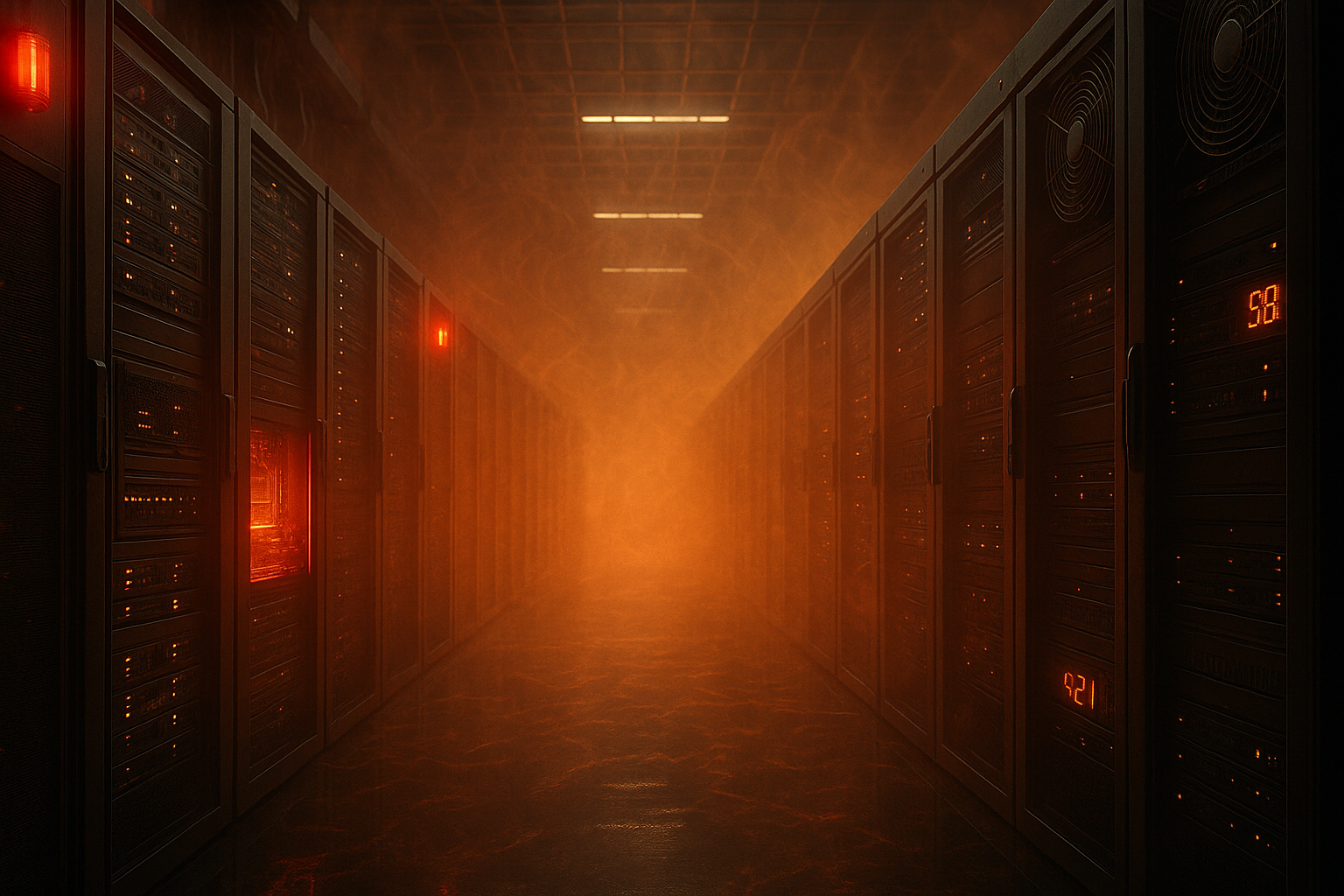
The data center industry stands at an inflection point. For decades, air cooling has been the reliable workhorse keeping servers humming in facilities worldwide. But as we enter the age of artificial intelligence, machine learning, and high-performance computing, that faithful cooling paradigm is gasping for air—literally.
The numbers tell a stark story. Modern GPU accelerators like NVIDIA’s A100 and H100 chips routinely exceed 300 watts each, with some configurations pushing beyond 700 watts per card. When you multiply this across dense AI clusters, the thermal challenge becomes staggering. Industry reports indicate that average rack power densities have doubled in just a few years, jumping from approximately 6 kW to 12-15 kW per rack. Yet even this dramatic increase is “still insufficient to support AI and high-density architecture” with traditional air cooling methods.
Traditional air-cooled data centers typically max out at 20 -30 kW per rack before hitting insurmountable thermal and airflow constraints. This limitation isn’t just an engineering inconvenience—it’s becoming an existential threat to the computing infrastructure that powers our digital economy.
The Perfect Storm: Multiple Pressures Converging
Exponential Growth in AI Workloads
The artificial intelligence revolution isn’t coming—it’s here, and it’s hungry for computing power. ChatGPT’s explosive adoption demonstrated that AI applications can scale from zero to hundreds of millions of users in months, not years. Behind each AI interaction lies an intricate web of GPU and accelerator clusters performing trillions of operations per second (TOPS), generating enormous amounts of heat in the process.
Large language models, computer vision systems, and deep learning applications require massive parallel processing capabilities that only GPU accelerators can provide efficiently. As these workloads become mainstream across industries—from healthcare and finance to entertainment and manufacturing—the demand for high-density computing infrastructure continues to surge.
Power Consumption Reaching Crisis Levels
The scale of power consumption in modern AI data centers is breathtaking. Projections suggest that AI computing could consume 8% of all U.S. electricity by 2030, representing a 160% increase in data center power demand driven specifically by artificial intelligence workloads. This isn’t sustainable growth—it’s an energy crisis in the making.
Consider that a single large-scale AI training run can consume as much electricity as a small city over several weeks. When multiplied across the thousands of AI models being developed and deployed globally, the cumulative energy demand becomes astronomical. Traditional cooling systems, which can account for 30-40% of a data center’s total energy consumption, are amplifying this problem rather than solving it.
Infrastructure Hitting Physical Limits
The phrase “our data centers have run out of air” isn’t hyperbole—it’s a technical reality. Air cooling systems are bumping against fundamental physics limitations. Air has inherently poor thermal conductivity compared to liquids, requiring massive volumes and high velocities to achieve meaningful heat transfer. The result is an increasingly complex ballet of hot and cold aisles, raised floors, sophisticated airflow management, and energy-intensive air conditioning systems that are struggling to keep pace with modern hardware demands.
Data center operators are finding themselves in impossible situations: they can either limit the computing density to what air cooling can handle (severely constraining their business capabilities), or they can push thermal limits and risk equipment failure, performance throttling, and reduced hardware lifespan
Economic Pressures: The Cost of Cooling Inefficiency
Energy Costs Spiraling Out of Control
Energy represents one of the largest operational expenses for data centers, typically accounting for 20-40% of total operating costs. With cooling systems consuming 30-40% of facility power, inefficient thermal management directly impacts profitability. As electricity prices continue to rise and carbon pricing mechanisms spread globally, the economic penalty for inefficient cooling becomes increasingly severe.
The inefficiency goes beyond just electricity bills. When servers thermal throttle due to inadequate cooling, they deliver reduced performance per watt, meaning organizations need to deploy more hardware to achieve the same computational outcomes. This creates a vicious cycle of increased capital expenditure, higher power consumption, and greater cooling demands.
Stranded Assets and Utilization Challenges
Many existing data centers are becoming stranded assets—fully functional facilities that simply cannot support modern high-density workloads. Retrofitting these facilities for higher power densities is often prohibitively expensive, requiring complete overhauls of electrical distribution, cooling infrastructure, and sometimes even building modifications.
This mismatch between existing infrastructure and modern computing requirements forces organizations into suboptimal compromises. They might spread workloads across multiple lower-density facilities, increasing complexity and reducing efficiency, or they might underutilize expensive hardware to avoid thermal constraints.
Environmental and Regulatory Pressures
Sustainability Mandates Tightening
Environmental, Social, and Governance (ESG) requirements are no longer optional for large organizations. Investors, customers, and regulators are demanding demonstrable progress toward net-zero emissions and improved energy efficiency. The data center industry, as a significant and growing consumer of electricity, faces particular scrutiny.
Some jurisdictions already require Power Usage Effectiveness (PUE) reporting for large data centers, and there’s growing momentum toward mandatory efficiency standards. The European Union’s energy efficiency directive, various U.S. state regulations, and corporate sustainability commitments are creating a regulatory environment where inefficient cooling isn’t just expensive—it’s potentially non-compliant.
Water Consumption and Availability
Traditional cooling systems often rely heavily on water for heat rejection through cooling towers and evaporative systems. As climate change intensifies and water scarcity becomes more common, data centers face increasing restrictions on water usage. Some regions are implementing water usage caps for new data center construction, while others are charging premium rates for industrial water consumption.
The competition for water resources between data centers and local communities is becoming a significant social and political issue, particularly in areas experiencing rapid data center growth. This external pressure adds another layer of urgency to finding more sustainable cooling solutions.
Grid Constraints and Infrastructure Limitations
Power Grid Bottlenecks
The electrical grid in many regions is struggling to keep pace with data center power demands. Utility companies report significant delays in providing new high-capacity electrical services, with some projects facing multi-year wait times for grid connections. This bottleneck is particularly acute in popular data center markets where multiple facilities are competing for limited grid capacity.
Regional transmission organizations (RTOs) and independent system operators (ISOs) are implementing new interconnection procedures, capacity queues, and costs that make inefficient facilities economically unviable. The combination of grid constraints and higher electricity demand means that energy efficiency isn’t just environmentally responsible—it’s operationally necessary for securing reliable power access.
Real Estate and Zoning Challenges
As data center power densities remain constrained by cooling limitations, operators often require more physical space or more dispersed deployments to achieve the same computational capacity. This drives up real estate costs and creates zoning conflicts in areas where land is scarce or expensive. Local communities are increasingly resistant to large, energy-intensive facilities that provide relatively few jobs while consuming substantial infrastructure resources.
The result is a growing mismatch between where computing capacity is needed (often in urban areas close to users) and where traditional data centers can be economically and politically viable to build and operate.
The Innovation Imperative
Technology Evolution Outpacing Infrastructure
The semiconductor industry continues to deliver more powerful processors, but these advances are increasingly focused on performance rather than power efficiency. Modern AI accelerators pack enormous computational capability into relatively small form factors, but the heat density per square inch is reaching levels that air cooling simply cannot handle effectively.
This trend shows no signs of slowing. Next-generation processors promise even greater performance, but they also threaten to widen the gap between computing capability and cooling infrastructure. Organizations that fail to evolve their thermal management strategies risk being unable to deploy cutting-edge hardware effectively.
Competitive Disadvantage of Inefficient Cooling
In an increasingly digital economy, computational capability directly translates to competitive advantage. Organizations constrained by cooling limitations cannot fully leverage modern AI and machine learning capabilities, potentially falling behind competitors who have solved the thermal management puzzle.
The performance impact extends beyond simple heat dissipation. Thermal stress reduces component reliability, increases maintenance costs, and can cause unpredictable performance variations that impact application quality and user experience.
Looking Ahead: The Urgent Need for Innovation
The convergence of these factors—exponential growth in computing demands, rising energy costs, environmental pressures, infrastructure constraints, and competitive requirements—creates an urgent imperative for cooling innovation. The industry cannot simply extrapolate existing air cooling approaches to meet future needs.
As one industry expert recently observed, we are entering “the era of liquid cooling” by necessity, not choice. The question is no longer whether data centers will need to adopt advanced cooling technologies, but how quickly they can implement solutions that break through current limitations while meeting economic and environmental requirements.
The cooling crisis facing data centers today represents both a significant challenge and an enormous opportunity. Organizations that proactively address thermal management will position themselves for the next decade of computing growth, while those that cling to traditional approaches may find themselves unable to compete in an increasingly AI-driven economy.
The solution to this crisis exists, but it requires rethinking fundamental assumptions about how we cool computing infrastructure. In our next article, we’ll explore how immersion cooling technology offers a path forward, providing the thermal management capabilities needed to support the next generation of high-performance computing workloads.
In the following article of this series, we’ll dive deep into the technical fundamentals of immersion cooling and explore how submerging servers in specialized fluids can solve the thermal challenges that traditional air cooling cannot address.