From Planning to Production:
Moving from theory to practice, we now face the ultimate test of our sizing methodology: applying it to real-world scenarios with actual constraints, budgets, and business objectives. The frameworks and calculations we’ve explored provide the analytical foundation, but successful AI infrastructure deployment requires navigating the messy realities of startup budgets, enterprise procurement cycles, regulatory requirements, and evolving business needs.
The most instructive aspect of AI infrastructure sizing isn’t the theoretical peak performance—it’s how different organizations solve similar problems with vastly different approaches based on their unique constraints. A startup building their first AI-powered product faces fundamentally different trade-offs than an enterprise training proprietary language models or a research institution pushing the boundaries of what’s computationally possible.
This diversity of approaches reveals an important truth: there’s no universal “right” answer to AI infrastructure sizing. The optimal solution depends on your specific workloads, financial constraints, operational capabilities, and strategic objectives. However, the methodology remains consistent 1) systematic measurement 2) careful analysis of trade-offs and 3) disciplined planning for both immediate needs and future growth.
What makes this particularly challenging is that AI infrastructure decisions often involve long-term commitments with significant financial implications. Unlike traditional enterprise software that can be easily swapped or upgraded, AI infrastructure choices influence everything from model architecture decisions to operational workflows. Getting these decisions right requires understanding not just current requirements, but how those requirements will evolve as your AI capabilities mature.
Startup MVP: Proving Concepts on Limited Budgets
Startups face the unique challenge of proving AI-powered business concepts while operating under severe resource constraints. Every infrastructure dollar must deliver immediate value while providing sufficient flexibility for rapid iteration and growth. This scenario demands creativity, efficiency, and careful risk management.
Scenario: Text Summarization MVP
Consider a small team developing a minimal viable product(MVP) for automated text summarization targeting legal documents. They’re using a fine-tuned transformer model with approximately 100 million parameters, aiming to validate their approach on a 10,000-document dataset within 48 hours while keeping hardware costs below $5,000 monthly.
Sizing Analysis
Compute Requirements The computational demands are relatively modest by modern AI standards. Each document requires approximately 2×10⁸ FLOPS for forward and backward passes through the model. Processing 10,000 documents across 5 training epochs totals roughly 10¹³ FLOPS.
A modern GPU like the NVIDIA H200 delivers nearly 2 petaFLOPS of peak FP16 performance, suggesting that raw computation could complete in under a second. However, real-world overhead from data loading, kernel launches, and framework inefficiencies typically increases this by 100-1000x, resulting in actual training times of several hours.
Memory and Storage Considerations The model’s 100 million parameters require approximately 400MB for weights, plus additional memory for optimizer states, gradients, and activations. The H200’s 141GB of HBM3e memory provides enormous headroom for this workload, allowing for large batch sizes and efficient processing.
Dataset storage requirements are minimal—10,000 legal documents typically consume less than 1GB of storage, with additional space needed for preprocessed data and model checkpoints.
Infrastructure Configuration For this startup scenario, a single H200 GPU provides more than sufficient compute power. The configuration includes:
- 1× NVIDIA H200 (on-demand access)
- 32GB system memory for data preprocessing
- 1TB NVMe SSD for datasets and checkpoints
- Standard network connectivity (1Gbps sufficient)
Cost Optimization Strategies Startups can leverage several approaches to minimize costs:
On-Demand Usage: Rather than purchasing or leasing hardware, on-demand GPU access allows paying only for actual compute time. For this workload, total GPU time might be less than 10 hours, making on-demand access significantly more cost-effective than fixed monthly commitments.
Spot Instance Strategy: For non-urgent training runs, spot instances can reduce costs by 70-90%. Since the training can be checkpointed and resumed, interruptions become manageable rather than catastrophic.
Development-Production Separation: Initial development and testing can occur on smaller, less expensive instances, with full-scale training reserved for final validation runs.
Lessons for Startups
This scenario demonstrates several key principles for startup AI infrastructure:
Start Minimal: The temptation to over-provision “for growth” often leads to unnecessary expenses during the critical early phase when capital efficiency matters most.
Embrace Flexibility: On-demand and spot instances provide cost flexibility that aligns with the uncertain requirements of early-stage development.
Focus on Learning: The primary goal isn’t optimal performance—it’s learning about your workload characteristics, user requirements, and business model validation.
Enterprise-Scale Training: Production AI at Scale
Enterprise AI training represents the opposite end of the spectrum—substantial budgets supporting business-critical applications with demanding performance, reliability, and compliance requirements. These deployments must balance cutting-edge performance with operational stability and long-term strategic alignment.
Scenario: Proprietary Language Model Development
Consider a large financial services firm developing a 100-billion parameter language model trained on proprietary financial documents, regulatory filings, and market data. The model must train on 1 trillion tokens within two weeks to meet regulatory deadline requirements, while maintaining strict data sovereignty and compliance controls.
Sizing Analysis
Massive Compute Requirements Training a 100-billion parameter model requires enormous computational resources. Each token requires approximately 4 × sequence_length × hidden_size FLOPS, totaling roughly 1.24×10²⁴ FLOPS for the complete training run.
To complete this within two weeks (1.21×10⁶ seconds), the system must sustain over 10¹⁸ FLOPS per second—requiring approximately 500+ H200 GPUs running continuously at high efficiency.
Memory and Networking Architecture The model’s size necessitates sophisticated memory management across hundreds of GPUs. Each H200’s 141GB of HBM3e memory contributes to a total of approximately 70TB of high-bandwidth memory across the cluster.
Distributed training at this scale generates enormous communication overhead. Gradient synchronization requires high-bandwidth, low-latency networking—typically 200Gbps InfiniBand connections with non-blocking fabric topology to prevent communication bottlenecks.
Infrastructure Configuration
- 64× 8-GPU nodes (512 total H200 GPUs)
- 200Gbps InfiniBand leaf-spine network
- 100TB distributed NVMe storage for datasets and checkpoints
- 1.2PB object storage for raw training data
- Dedicated cooling infrastructure to handle 3+ MW heat load
Enterprise-Specific Considerations
Reliability and Fault Tolerance: Two-week training runs represent enormous investments—hardware failures become existential risks. The infrastructure must include redundant systems, automated checkpointing, and rapid recovery capabilities.
Security and Compliance: Financial data requires sophisticated access controls, encryption, and audit capabilities. The infrastructure must support regulatory requirements while maintaining performance.
Operational Integration: Enterprise deployments must integrate with existing IT management systems, security frameworks, and operational procedures.
Advanced Cooling: The Performance Enabler
At enterprise scale, cooling infrastructure becomes critical for sustained performance. Traditional air cooling struggles with the heat density generated by high-performance AI workloads, often leading to thermal throttling that reduces actual performance by 10-30%.
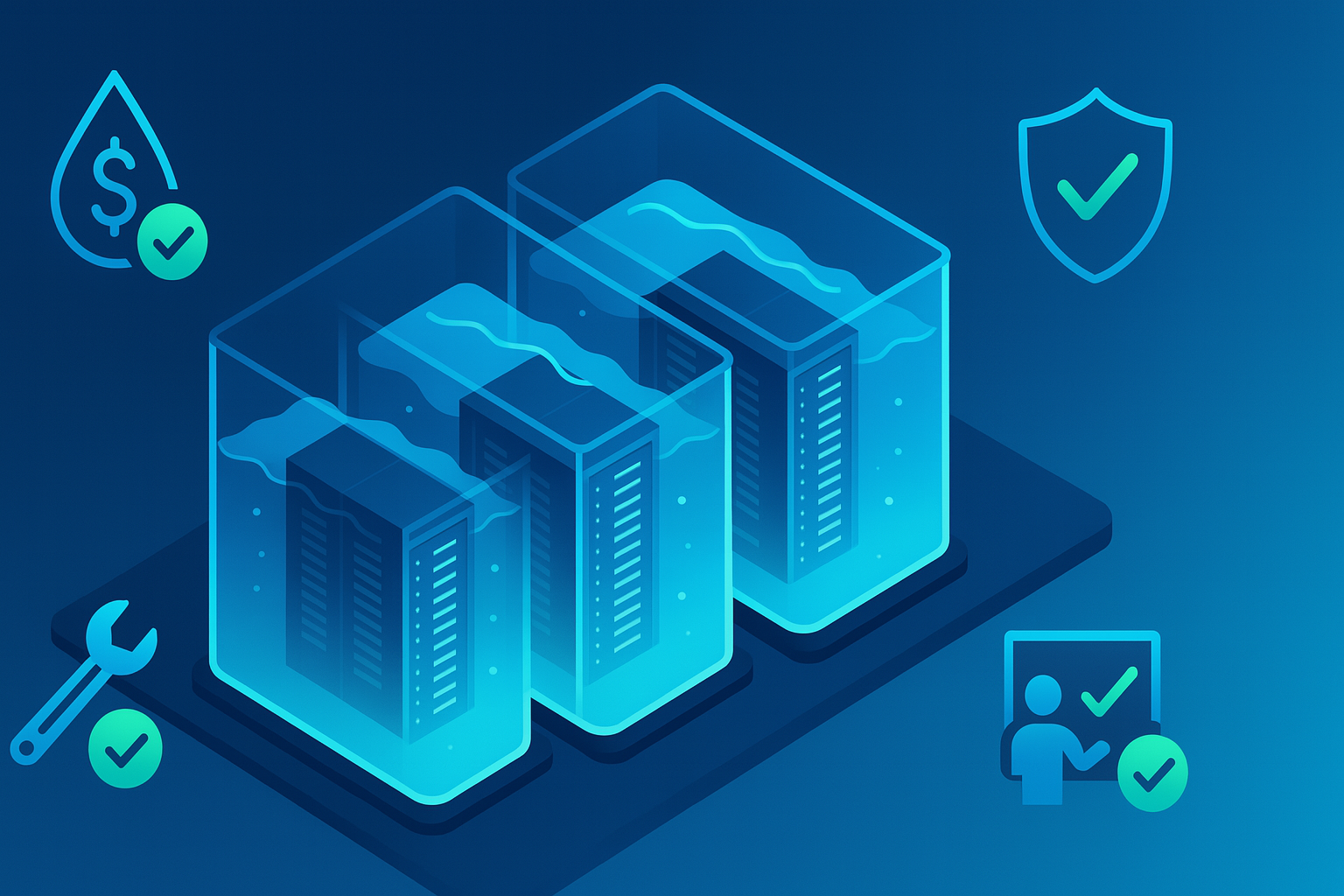
Immersion Cooling Advantages Modern immersion cooling solutions address these limitations by:
Eliminating Thermal Throttling: Consistent temperatures ensure GPUs operate at full performance throughout extended training runs.
Improving Density: Higher compute density reduces facility footprint and network distances, improving both cost efficiency and performance.
Reducing Power Consumption: Eliminating fans and optimizing cooling efficiency can reduce total power consumption by 15-18%.
Extending Hardware Lifespan: Stable thermal environments and elimination of dust and vibration can extend GPU lifespan by 30-60%.
Distributed Edge Inference: AI at the Network Edge
Edge AI deployment creates unique infrastructure challenges that differ significantly from centralized training or cloud-based inference. These systems must balance performance requirements with space, power, and connectivity constraints while maintaining reliability across distributed locations.
Scenario: Real-Time Video Analytics for Retail
Consider a retail chain deploying computer vision analytics across 200 store locations, processing 4K video streams in real-time for customer behavior analysis, inventory monitoring, and security applications. Each location requires 30fps processing with sub-50ms latency to support real-time alerting and response.
Sizing Analysis
Edge Compute Requirements Each location processes high-resolution video streams using optimized computer vision models—typically YOLO-class object detectors requiring approximately 10 GFLOPS per inference operation.
At 30fps, each location requires sustained throughput of 300 GFLOPS. Modern GPUs like the H200 provide sufficient performance headroom to handle this workload while leaving capacity for additional applications or traffic spikes.
Distributed Infrastructure Challenges
Local Processing Requirements: Real-time response demands local inference capability rather than cloud-based processing, which would introduce unacceptable latency.
Connectivity Limitations: Many retail locations have limited bandwidth, making it impractical to stream raw video to centralized processing facilities.
Operational Complexity: Managing 200 distributed locations requires sophisticated remote monitoring, automated updates, and failure recovery systems.
Edge Infrastructure Configuration Per location:
- 1× H200 GPU optimized for inference workloads
- 16GB system memory for video buffering
- 1TB NVMe storage for model cache and local data
- 100Mbps WAN connectivity for management and alerts
Edge-Specific Optimizations
Model Optimization: Edge deployment benefits from model compression, quantization, and specialized inference optimizations that reduce computational requirements without significantly impacting accuracy.
Local Caching: Storing models and frequently accessed data locally reduces dependency on network connectivity and improves response times.
Hierarchical Processing: Edge devices handle real-time processing while periodically uploading summaries and alerts to centralized systems for analysis and management.
Edge Infrastructure Trends
The growth of edge AI reflects several important technology and business trends:
Latency Requirements: Many AI applications require response times that make cloud-based processing impractical, driving compute closer to data sources.
Data Sovereignty: Regulatory and privacy requirements increasingly favor local processing over centralized cloud systems.
Network Economics: Processing data locally can be more cost-effective than streaming large volumes of data to centralized facilities.
Distributed Intelligence: Edge AI enables applications that would be impossible with centralized architectures, such as autonomous vehicles or industrial control systems.
Total Cost of Ownership: Beyond Hardware Costs
Understanding the complete financial impact of AI infrastructure requires looking beyond initial hardware purchases to encompass the full lifecycle costs of deployment, operation, and evolution.
Strategic Cost Optimization
Reserved vs. On-Demand Capacity Organizations can achieve significant cost savings by balancing reserved capacity for predictable workloads with on-demand access for variable requirements.
Reserved Capacity Benefits: Long-term commitments (1-3 years) typically provide 30-60% cost savings compared to on-demand pricing while guaranteeing access to scarce GPU resources.
On-Demand Flexibility: Variable workloads, experimental projects, and burst capacity needs often benefit from on-demand access despite higher per-hour costs.
Hybrid Strategies: Many organizations optimize costs by reserving capacity for baseline requirements while using on-demand access for peaks and experiments.
Spot and Preemptible Instances For fault-tolerant workloads, spot instances can provide up to 90% cost savings compared to on-demand pricing.
Workload Suitability: Batch training jobs, research experiments, and development workloads often tolerate interruptions well when combined with checkpointing strategies.
Risk Management: Sophisticated orchestration systems can automatically migrate workloads between spot and on-demand instances based on availability and cost optimization.
Resource Utilization Optimization
Dynamic Scheduling and Consolidation Advanced scheduling systems can dramatically improve hardware utilization while reducing operational costs.
Workload Consolidation: Co-locating compatible workloads on shared infrastructure maximizes hardware utilization while minimizing idle resources.
Predictive Allocation: AI-driven resource allocation can anticipate demand patterns and pre-position resources to optimize both performance and cost.
Multi-Tenancy: Sophisticated isolation and quality-of-service mechanisms enable multiple teams or projects to share infrastructure efficiently.
Performance Per Dollar Optimization True cost optimization requires understanding performance per dollar rather than simply minimizing infrastructure costs.
Throughput Optimization: Higher-performance infrastructure that completes workloads faster can provide better cost efficiency than cheaper, slower alternatives.
Energy Efficiency: Power costs represent a significant portion of total cost of ownership, making energy-efficient infrastructure financially attractive beyond environmental considerations.
Operational Efficiency: Infrastructure that requires less operational overhead can provide better total cost of ownership despite higher initial costs.
Advanced Infrastructure Solutions
Immersion Cooling ROI Advanced cooling technologies like immersion cooling provide quantifiable financial benefits beyond just enabling higher performance:
Energy Savings: 15-18% reduction in power consumption translates directly to operational cost savings over the infrastructure lifecycle.
Density Improvements: Higher compute density reduces facility costs per GPU, including real estate, networking, and support infrastructure.
Reliability Benefits: Extended hardware lifespan and reduced failure rates improve total cost of ownership while reducing operational disruption.
Performance Consistency: Eliminating thermal throttling ensures organizations receive full value from their hardware investments.
Implementation Best Practices
Successful AI infrastructure deployment requires careful attention to operational considerations that extend beyond pure performance optimization.
Deployment Strategy
Phased Implementation Rather than deploying complete infrastructure immediately, successful organizations often adopt phased approaches that allow learning and adaptation:
Pilot Deployments: Small-scale initial deployments validate assumptions and identify optimization opportunities before larger investments.
Incremental Scaling: Modular infrastructure design enables efficient scaling by adding standardized components rather than redesigning systems.
Technology Refresh Planning: Regular evaluation of new technologies against existing infrastructure helps identify optimal upgrade timing and approaches.
Monitoring and Optimization
Comprehensive Telemetry Effective AI infrastructure requires monitoring systems that capture the complex interactions between different system components:
GPU Utilization: Beyond simple utilization percentages, monitoring should capture memory bandwidth, thermal performance, and computational efficiency.
Network Performance: Distributed AI workloads generate complex communication patterns that require specialized monitoring to identify bottlenecks.
Storage I/O: Data loading performance often limits overall system throughput, making storage monitoring critical for optimization.
Continuous Optimization AI infrastructure performance isn’t static—it requires ongoing attention and optimization as workloads evolve:
Regular Profiling: Periodic re-profiling of workloads helps identify optimization opportunities and changing requirements.
Capacity Planning: Monitoring utilization trends enables proactive capacity planning rather than reactive emergency expansions.
Cost Management: Regular review of costs relative to utilization helps identify optimization opportunities and unused resources.
Operational Integration
Skills and Training AI infrastructure often requires specialized operational knowledge that differs from traditional IT infrastructure:
Technology-Specific Training: Advanced technologies like immersion cooling, high-speed networking, and GPU cluster management require specialized skills.
Cross-Functional Collaboration: Successful AI infrastructure requires collaboration between infrastructure teams, data scientists, and business stakeholders.
Vendor Relationship Management: Complex AI infrastructure often involves multiple vendors and technologies that require coordinated support and management.
The Future of AI Infrastructure
As AI capabilities continue advancing and deployment patterns evolve, several trends are reshaping infrastructure requirements and optimization strategies.
Emerging Technologies
Next-Generation Accelerators Hardware evolution continues accelerating, with each generation providing significant improvements in performance, efficiency, and capabilities:
Performance Scaling: New accelerator generations typically provide 2-3x performance improvements while often reducing power consumption.
Memory Improvements: High-bandwidth memory capacities and speeds continue increasing, enabling larger models and more efficient processing.
Specialized Features: New hardware generations often include specialized features optimized for specific AI workloads or emerging algorithms.
Advanced Cooling Solutions Cooling technology continues evolving to address the thermal challenges of increasing compute density:
Immersion Cooling Maturation: What was once experimental technology is becoming mainstream for high-density AI deployments.
Efficiency Improvements: New cooling technologies provide better efficiency, reliability, and operational simplicity.
Integration Optimization: Better integration between cooling systems and AI hardware improves overall system efficiency and reliability.
Deployment Pattern Evolution
Edge AI Growth The trend toward distributed AI processing continues accelerating, driven by latency requirements, data sovereignty concerns, and network economics:
Micro Data Centers: Purpose-built facilities optimized for edge AI deployment are emerging as an important infrastructure category.
Distributed Training: New algorithms and networking technologies enable efficient distributed training across geographically separated resources.
Hybrid Architectures: Organizations increasingly adopt hybrid approaches that combine centralized training with distributed inference.
Sustainability Focus Environmental considerations are becoming increasingly important in AI infrastructure planning:
Energy Efficiency: Organizations prioritize infrastructure that maximizes computational output per unit of energy consumption.
Renewable Integration: AI infrastructure increasingly incorporates renewable energy sources and energy storage systems.
Lifecycle Management: Comprehensive approaches to hardware lifecycle management minimize environmental impact while optimizing costs.
Your Next Steps
The methodology and examples we’ve explored provide a framework for approaching AI infrastructure sizing decisions, but successful implementation requires applying these concepts to your specific requirements, constraints, and objectives.
Sizing Assessment
Whether you’re planning your first AI infrastructure deployment or optimizing existing systems, the key is starting with comprehensive measurement and analysis of your actual workloads. Generic benchmarks and vendor recommendations provide useful starting points, but optimal infrastructure requires understanding your specific performance patterns, bottlenecks, and growth requirements.
Tools like ImmersionIQ’s GPU sizing calculator can help translate workload requirements into concrete hardware specifications while accounting for safety margins, growth planning, and cost optimization opportunities. These tools combine the methodology we’ve discussed with current hardware specifications and pricing to provide realistic deployment options.
Strategic Planning
Successful AI infrastructure deployment requires balancing immediate needs with strategic flexibility. The organizations that succeed are those that can deploy infrastructure that meets current requirements while providing pathways for growth, technology refresh, and evolving business needs.
This often means choosing modular architectures that can scale incrementally, working with vendors who provide clear upgrade paths, and implementing monitoring systems that provide visibility into utilization patterns and optimization opportunities.
Continuous Evolution
Perhaps most importantly, AI infrastructure optimization isn’t a one-time activity—it’s an ongoing process that requires continuous attention as workloads evolve, technologies advance, and business requirements change. The organizations that achieve the best return on their AI infrastructure investments are those that treat infrastructure as a dynamic capability rather than a static asset.
The future belongs to organizations that can efficiently translate AI potential into business value while managing the costs and complexity of advanced computing infrastructure. Whether you’re building your first AI-powered application or scaling to enterprise-level AI operations, the systematic approach to infrastructure sizing we’ve explored provides the foundation for making informed decisions that support both immediate success and long-term growth.
The AI revolution is still in its early stages, and the infrastructure decisions you make today will either enable or constrain your capabilities for years to come. By combining rigorous methodology with strategic thinking and continuous optimization, you can build AI infrastructure that becomes a competitive advantage rather than just a cost center.